Mercer Island, WA
Siding Replacement in Mercer Island, WA
Most of Mercer Island’s houses are mid-century, and so is their siding. King County assessor records put the median build year of the island’s 7,126 single-family homes at 1969, which places the typical house squarely in the 1950–79 build era. Siding replacement in Mercer Island usually starts with identifying what that era left on the walls. From there, the job is choosing a material that suits Eastside rain, waterfront lots and homes valued well above the county median.
What’s on Mercer Island homes now
Assessor records split the island’s housing stock into four eras, and each one tends to carry a different kind of siding.
- Before 1950 (6%): likely original wood lap siding. Old paint layers on these homes may contain lead.
- 1950 to 1979 (62%): cedar, T1-11 plywood panels or asbestos-cement shingles. Asbestos-cement may contain asbestos and should be tested before removal.
- 1980 to 1999 (15%): composite and hardboard siding. Within that group, 10% of homes date from 1985 to 1996, when LP siding was common.
- 2000 and later (16%): fiber cement or builder-grade vinyl that is reaching its first repaint or replacement.
The older subdivisions show how concentrated the mid-century stock is:
| Neighborhood | Homes | Median year built |
|---|---|---|
| Mc Gilvras Island Add | 288 | 1974 |
| East Seattle Add | 273 | 1959 |
| Allview Heights Add | 193 | 1967 |
| Madrona Crest Add | 180 | 1961 |
| Island Park Replat Of | 155 | 1967 |
| Mercerdale Add | 131 | 1959 |
Census data shows 67% of housing units on Mercer Island are detached houses, with apartments making up 31%. Among single-family homes, assessor records rate 59% in good or very good condition, and 12% have a recorded renovation.
Choosing siding for Mercer Island’s conditions
The siding types we usually recommend are vinyl, the Evergreen Shield Siding System and metal, with stacked stone or stone veneer as accents. None of the three is wood, so moderate Eastside rain won’t rot them. Here is how local data points toward each one.
Higher-end homes: Evergreen Shield Siding System or metal. Census data puts the median home value on Mercer Island at $2,000,000, and assessor records grade 64% of houses at 9 or above, the higher end of the county scale. Owners of homes like these more often choose a premium material, and both of these suit a long-term upgrade.
Electric heat: Evergreen Shield Siding System. Electricity heats 38% of homes on the island, according to the Census, with gas covering 58%. Where the furnace runs on electricity, insulation counts for more, and these panels carry an insulating graphite membrane rated R-2.0, against R-0.61 for standard vinyl.
Large walls on a budget: vinyl. With a median of 3,100 square feet and 48% of homes at two stories or more, wall area adds up fast. Vinyl is the most versatile and least expensive option, which keeps a big job manageable.
Waterfront lots: vinyl or Evergreen Shield Siding System. Assessor records list 10% of homes as waterfront and 36% with a view. On lakefront houses we use corrosion-resistant fasteners and flashing with either material.
Entries and base courses: stone accents. Stacked stone or stone veneer can frame an entry, wrap columns or a chimney, or run as a wainscot along the base, paired with any of the three siding types.
The right choice for your house comes out of the free in-home consultation, where we look at your walls, your heating and your goals together.
Evergreen Shield Siding System in Mercer Island
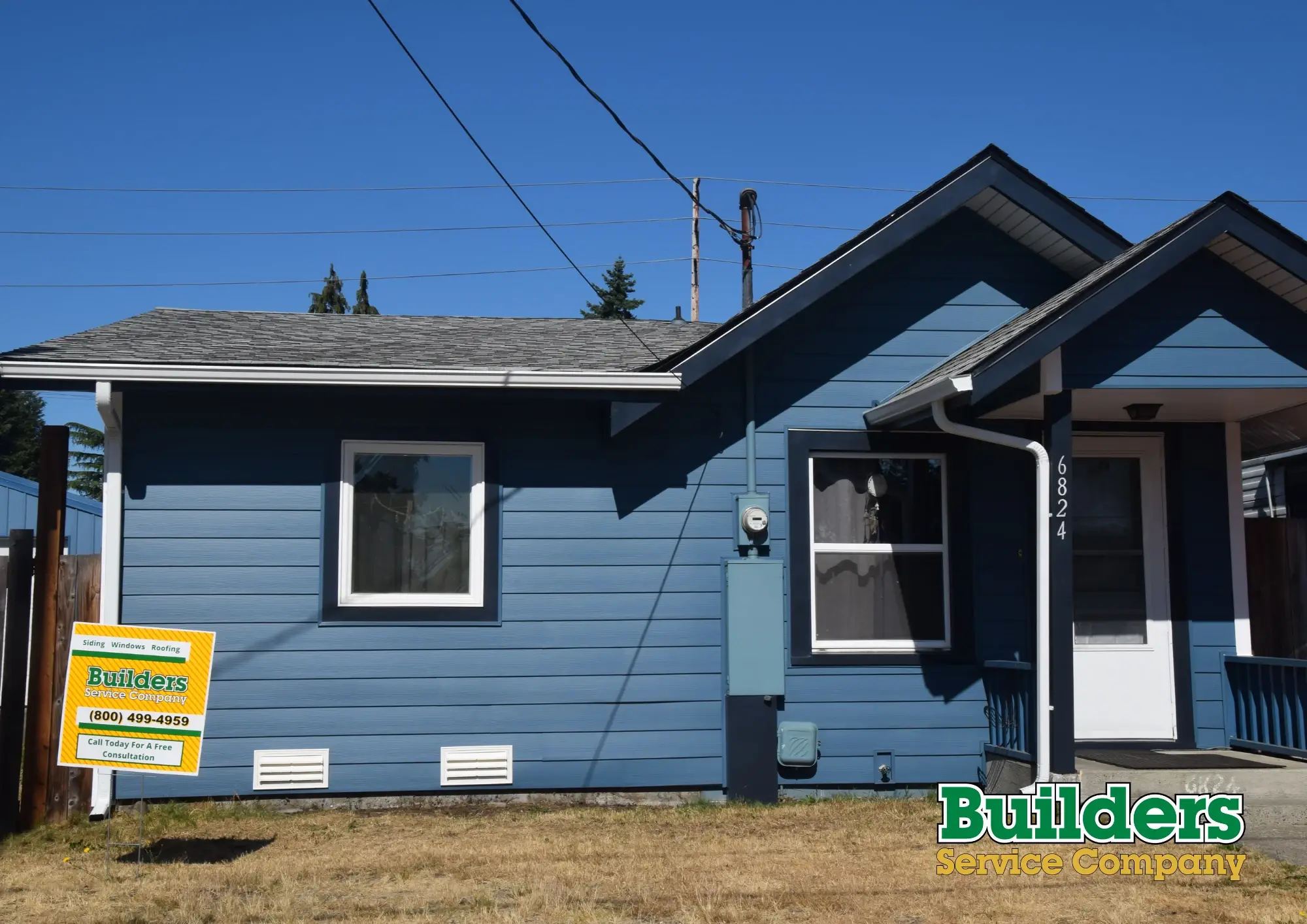
The Evergreen Shield Siding System is our exclusive insulated composite siding, designed for the Pacific Northwest climate. Two of its approved features line up with conditions on the island.
First, the composite material is built for water resistance against long wet seasons, humidity, mold and mildew. That suits the Eastside’s moderate rain and the island’s waterfront lots. Unlike the cedar on many 1950s and 1960s houses here, it won’t need repainting after a wet winter.
Second, it comes in 20 built-in, fade-resistant colors that resist chipping, peeling and fading. For a neighborhood with design review, a fixed color set makes it simple to show exactly what the finished house will look like.
Signs your siding needs replacing
Most Mercer Island siding is from the 1950–79 era, so the warning signs tend to be those of aging wood and mineral shingles.
- Mold and discoloration on cedar or T1-11, especially on shaded walls that stay damp through the rainy months.
- Cracks and gaps in old panels and shingles, where water can reach the sheathing.
- Swelling or soft edges on hardboard from 1985 to 1996, the LP siding era, which has a known history of moisture failure.
- Dents and maintenance that never ends, such as repainting and patching the same walls every few years.
If you see these on a house with 1960s siding, a walk-around at the consultation will tell you whether repair or replacement makes more sense.
Get a free siding consultation in Mercer Island
Schedule a free in-home consultation or call our Seattle office at 206-430-1927. We bring samples to your home, and our installations carry a lifetime warranty. Discounts are available for seniors, active military, veterans and first responders, and financing is available. For roofing, windows and decks, see our Mercer Island home exterior services.
Mercer Island siding FAQ
Which siding holds up best to Mercer Island's rain and lakefront exposure?
Any of the three types we usually recommend will handle it, because none of them is wood and none of them rots. The Eastside gets moderate rain, and assessor records list 10% of Mercer Island homes as waterfront. For those lots we lean toward vinyl or the Evergreen Shield Siding System, installed with corrosion-resistant fasteners and flashing. Its composite panels are built to resist water, humidity, mold and mildew through long wet seasons.
My house was built in the 1960s. What should I expect when the old siding comes off?
Expect testing first, then tear-off. Homes from 1950 to 1979 often have cedar, T1-11 or asbestos-cement shingles, and asbestos-cement may contain asbestos and should be tested before removal. That era covers most of the island: Allview Heights Add and Island Park Replat Of both have a median build year of 1967. Once results are back, we schedule removal and install the new siding you chose.
Is a large Mercer Island home a good candidate for vinyl siding?
Yes, vinyl is often the practical choice for a big house. It is the most versatile and least expensive of the types we usually recommend, which matters when the median single-family home on the island has 3,100 square feet. If heating cost is a concern, compare it with the insulated Evergreen Shield Siding System, rated R-2.0 against R-0.61 for standard vinyl. We price both options on your walls during the consultation.
Do I need Class A fire-rated siding on Mercer Island?
It is not a must here. The U.S. Forest Service rates Mercer Island's wildfire risk as low, at the 46th percentile in Washington, so we don't steer homes toward Class A siding for fire reasons alone. If you want it anyway, the Evergreen Shield Siding System carries a Class A fire rating, the highest fire-resistance rating for construction materials, and metal siding is another option to talk through.
Can you help me choose colors that fit my neighborhood's design review?
Yes, color and profile choices are part of the free in-home consultation. Design review is a local factor on Mercer Island, and some higher-value Eastside neighborhoods have HOA review of exterior changes. We bring samples to your home so you can see them against your trim and roof, and the Evergreen Shield Siding System offers 20 built-in, fade-resistant colors that you can take to your HOA when it asks for them.