Anacortes, WA
Siding Replacement in Anacortes, WA
Anacortes sits on Fidalgo Island, where marine wind and salt air shape a siding job more than rain does. Rainfall here is lower, but walls facing the water take steady salt exposure, and that wears on fasteners, flashing and painted finishes long before the panels themselves fail. The median Anacortes home was built in 1989, so many houses are now on their first siding, and plenty of it is reaching the end of its service life. This page covers what is on those homes and what we would put back.
What’s on Anacortes homes now
Census data shows the city’s 8,801 housing units span every era, without one dominant decade:
- Before 1950 (16%): likely original wood lap siding, often painted many times. That paint may contain lead, which shapes how we plan removal.
- 1950–1979 (24%): cedar, T1-11 plywood panels or asbestos-cement shingles. Asbestos-cement may contain asbestos and should be tested before removal.
- 1980–1999 (31%): composite and hardboard siding, including LP siding. This is the largest group in town.
- 2000 and later (30%): fiber cement or builder-grade vinyl, now reaching its first repaint or replacement.
With the two newest eras nearly even, an Anacortes siding project is as likely to involve tired builder-grade vinyl as aging hardboard.
Most of the work is on single-family houses. Detached homes make up 77% of the housing stock, attached homes such as townhouses 12%, and mobile homes 2%. On attached homes, a shared wall changes how a new siding layout meets the neighbor’s, which we sort out before ordering material. Census data also shows 70% of homes are owner-occupied, which means many households plan to stay long enough for a durable exterior to pay off.
Choosing siding for Anacortes’s conditions
We usually recommend three siding types, plus stone accents, and settle on the right one for your house during the free in-home consultation. On Fidalgo Island, these are the matches that hold up:
Salt air points to vinyl or the Evergreen Shield Siding System. Both shrug off marine moisture, and neither is wood, so there is nothing to rot or strip and repaint. Whichever you choose, we pair it with corrosion-resistant fasteners and flashing and with trim finishes rated for marine exposure. On a waterfront lot, those details decide how long the wall looks right.
Vinyl for large wall areas and tighter budgets. Vinyl is the most versatile and least expensive of the three. It comes in horizontal and vertical styles, several textures and finishes, and profiles that mimic wood clapboard, board-and-batten or shakes, which suits the many older Anacortes homes that started with lap siding.
Premium materials for higher-value homes. The median Anacortes home is valued at about $695,000. Owners at that level more often choose the Evergreen Shield Siding System or metal siding for a longer-term upgrade. Metal siding is also available on its own, and we discuss where it fits on your house.
Insulated siding for electric-heated homes. Gas heats 70% of local homes, but 27% heat with electricity. In those houses, the insulating layer in the Evergreen Shield Siding System pays back more, because each unit of heat costs more to replace.
Wildfire is a secondary concern here. The U.S. Forest Service puts Anacortes at the 59th percentile statewide, a Low rating, so salt air and wind should lead the decision.
Stone accents to finish the house. Stacked stone and stone veneer are accent cladding, not whole-house siding. They work on entries, wainscots, columns and chimneys alongside any of the three siding types.
Evergreen Shield Siding System in Anacortes
The Evergreen Shield Siding System is our exclusive insulated composite siding, designed for the Pacific Northwest climate. Two of its approved features fit Fidalgo Island homes in particular.
First, it is insulated. An insulating graphite membrane gives it a thermal resistance of R-2.0, compared with R-0.61 for standard vinyl siding. That matters most in electric-heated homes, where each unit of heat costs more.
Second, its 20 built-in colors resist chipping, peeling and fading, so there is no repainting. Where wind carries salt across exposed walls, a painted finish is usually the first thing to show wear; with these panels, there is no paint film to maintain. Unlike cedar, the panels won’t need to be scraped and recoated as the years go by.
Signs your siding needs replacing
Each era of Anacortes housing shows wear differently:
- 1980s and 1990s hardboard or LP siding: swelling, softening or flaking along the bottom edges and around nail heads, where moisture gets into the board. This is the most common failure we expect to see in town, given how many homes date from those years.
- 2000s builder-grade vinyl: cracked, warped or loose panels on the walls that take the brunt of marine wind.
- Walls facing the water: rust streaks below nails, fasteners or flashing, a sign that salt air has corroded hardware that was not rated for it.
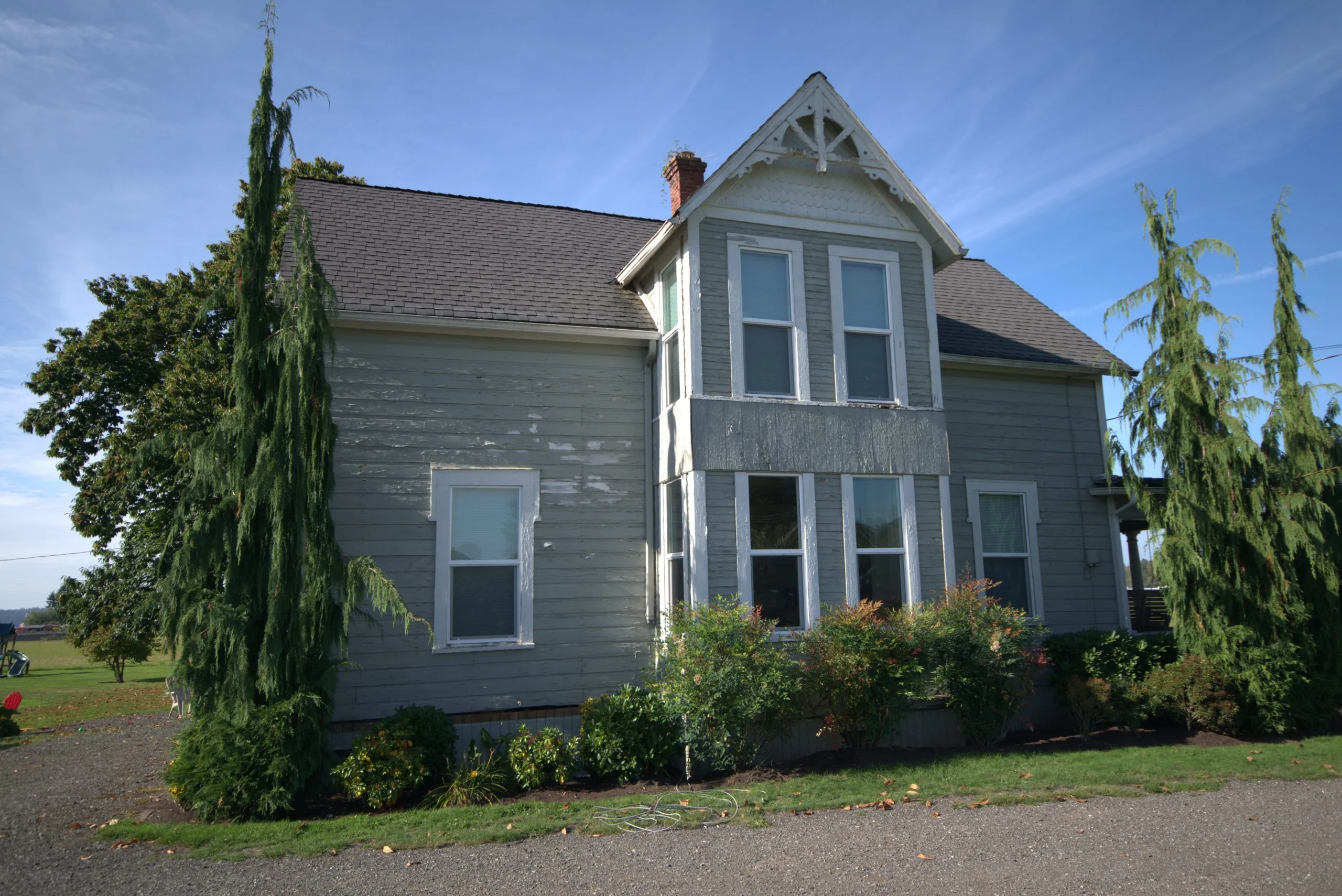
- Pre-1950 wood lap siding: paint that no longer holds on for long after a repaint, or boards that have split and pulled away.
If several of these show on one wall, replacement usually makes more sense than patching.
Get a free siding consultation in Anacortes
Schedule a free in-home consultation or call our Seattle office at 206-430-1927. We offer financing, a lifetime warranty, and discounts for seniors, active military, veterans and first responders. For roofing, windows and decks on the same house, see our Anacortes home exterior services.
Anacortes siding FAQ
Which siding holds up to salt air on Fidalgo Island?
Vinyl siding and the Evergreen Shield Siding System are the two types we usually recommend for salt-air exposure, and metal siding is also available. On the island the installation details matter as much as the panels: we use corrosion-resistant fasteners and flashing and finishes rated for marine exposure, especially on walls that face the water. We choose among them with you at the free in-home consultation.
What should I expect when removing siding from an Anacortes home built in the 1980s or 1990s?
Expect hardboard or composite siding, and possibly LP siding, which has a known history of moisture failure. About 31% of Anacortes homes date from 1980 to 1999, so this is the removal we plan for most often here. Once the old boards are off, we can see the sheathing and repair any damage before the new siding goes on.
Does wildfire risk change the siding choice in Anacortes?
Usually not. The U.S. Forest Service rates Anacortes's wildfire risk Low, at the 59th percentile in Washington, so salt air and wind drive most decisions here. If fire resistance matters to you, the Evergreen Shield Siding System carries a Class A fire rating, the highest fire-resistance rating for construction materials, and stacked stone or stone veneer near the ground is noncombustible.
Is insulated siding worth it if my Anacortes home heats with electricity?
It is worth a look, because insulated siding pays back more where heating is costly. Census data shows 27% of Anacortes homes heat with electricity, while 70% use gas. The Evergreen Shield Siding System has an insulating graphite membrane rated R-2.0, compared with R-0.61 for standard vinyl siding. We do not quote savings figures, but we can compare it with vinyl and metal for your house.
Can my older Anacortes house keep a traditional look with new siding?
Yes. Vinyl siding comes in styles that mimic classic wood clapboard, board-and-batten and shakes, in horizontal and vertical layouts. About 16% of Anacortes homes were built before 1950, and many of them started with wood lap siding, so a lap profile keeps the original character. Stacked stone or stone veneer can finish a porch, column or chimney on the same house.